There is a quiet shift happening in global medical travel. It is not that patients have stopped crossing borders for treatment. It is that they are recalibrating how, where, and when they travel.
Instead of asking only “which is the best hospital for my surgery”, patients are now asking “which is the best country to travel to right now” and “is it safe to travel for surgery right now”. Search interest around safe countries for medical treatment in 2026 and medical travel during war in the Middle East reflects this change clearly. The quality of clinical care still matters, but predictability, travel continuity and geopolitical risk have moved much higher up the decision ladder.
India sits right in the middle of this conversation, not as a new discovery but as a destination that many patients are actively reconsidering.
What The Data Actually Shows
On the ground, the picture is more nuanced than “medical tourism is down” or “India is booming”. For most providers and coordinators working with the Middle East, three things are true at the same time:
- Enquiries from certain Middle East markets have dropped by roughly 25 to 30 percent in recent months as patients pause or defer decisions.
- Actual arrivals from the region have, at times, dipped by 50 to 75 percent when flight routes were disrupted or airspace became unstable.
- Historically, the Middle East has contributed close to one quarter of inbound international patients for many Indian hospitals and facilitator networks.
This is important context. What we are seeing is a mobility and timing disruption, not a collapse in underlying demand. High-acuity cases in oncology, cardiac surgery, neurosurgery, and transplant do not simply disappear because of geopolitical risk. They move, they wait, or they choose different routes, but the medical need remains.
In parallel, India’s broader medical tourism market is still on an upward trajectory. Official and industry estimates suggest the sector could reach around 13 billion USD by 2026, up from roughly 6 to 9 billion USD in 2022, supported by sustained policy focus and private investment. That growth is not driven only by one geography or one conflict, which is why the current disruption feels sharper to Middle East focused players than to the ecosystem as a whole.
The Real Story: Search Behaviour Has Moved
If you look at how patients and families are searching, the story becomes clearer. The queries showing up in consultations and inboxes are changing:
- “alternatives to Turkey for medical tourism”
- “best country for surgery now”
- “affordable treatment outside Middle East”
- “where can I get treatment without delay”
In other words, patients are expanding their consideration set. Instead of one familiar route, they are looking at a portfolio of countries that feel safer, more stable, and more predictable from a travel perspective.
India is not appearing for the first time in these searches. For many, it is a known destination that is being reconsidered: a place they may have short-listed previously for affordability and clinical expertise, now revisited through the lens of stability and access.
For coordinators, hospitals, and agencies, this is the layer that really matters. It is no longer about pushing one country for every patient. It is about helping people navigate a more complex risk map, while still making sure the medical decision stays at the centre.
Where India Stands In This Recalibration
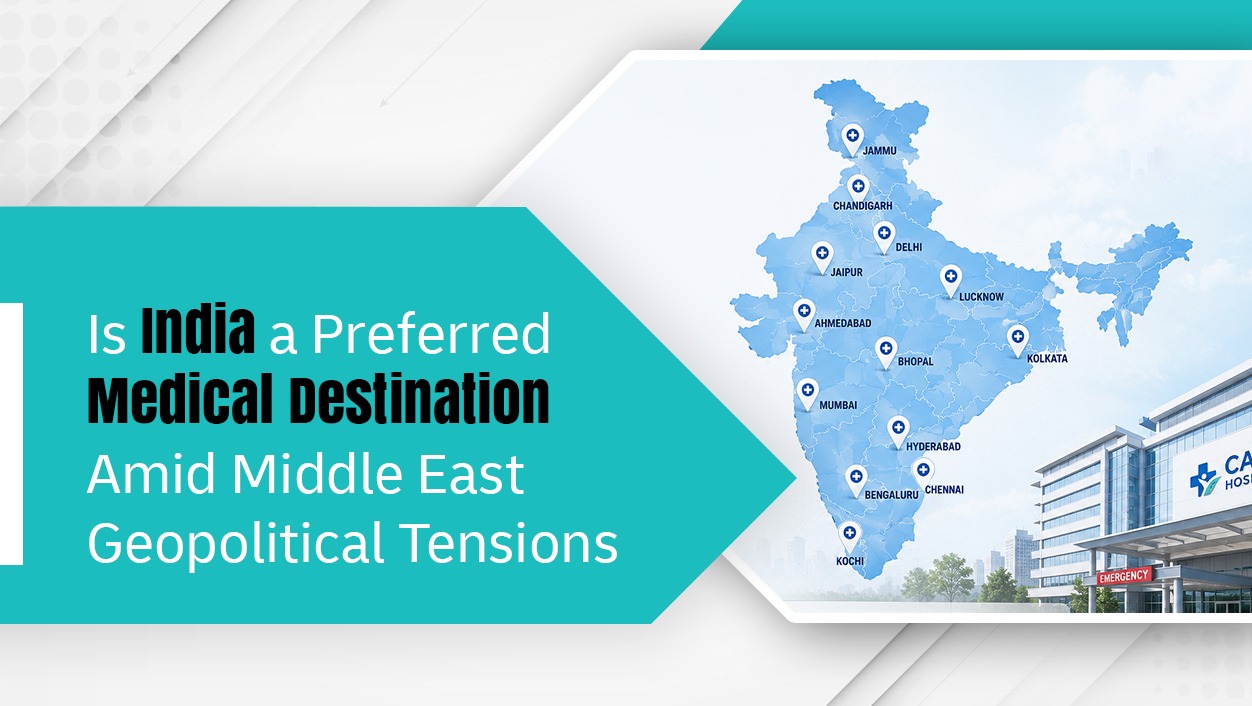
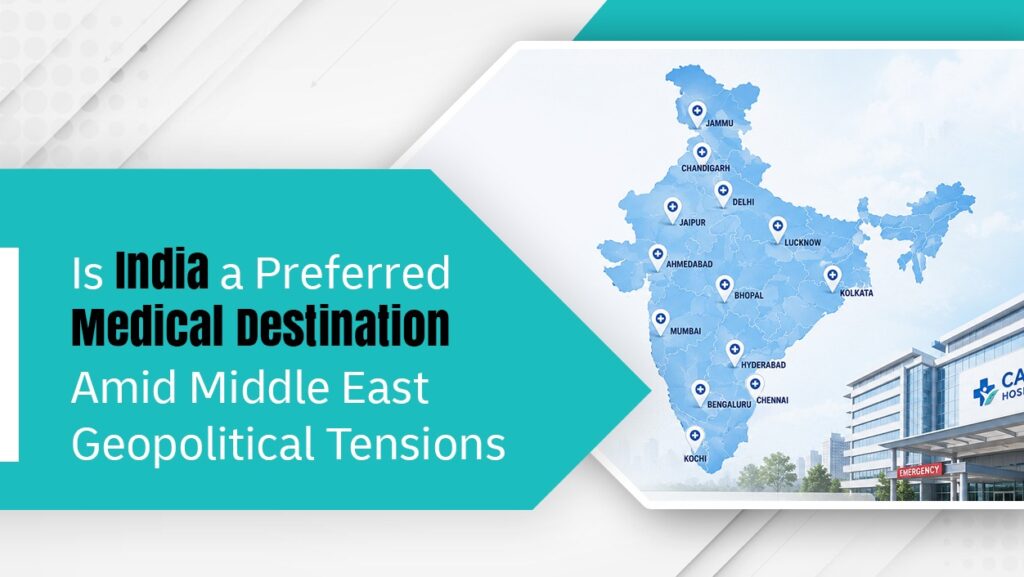
India’s positioning in this environment is largely structural. It does not sit inside the active conflict zones of the Middle East, but it is still geographically accessible from the region, from Africa, and from parts of Eastern Europe and Central Asia. Flight times remain manageable, even when certain corridors are temporarily rerouted.
Clinically, India already has a mature tertiary care ecosystem with depth in exactly the kind of high-acuity treatments that do not get postponed indefinitely: advanced cardiac surgery, complex oncology, transplants, orthopaedic reconstruction, and high-end critical care.
Cost advantage remains relevant, especially for patients comparing treatment prices with Western Europe or North America. However, for a growing share of international patients, the decision has shifted from “cheapest country” to “which destination gives me predictable access and a structured care pathway at a rational price”.
Multiple reports underline that India’s medical tourism segment is expected to grow strongly over the next decade, with double-digit CAGR projected through 2034, driven by both cost competitiveness and clinical reputation. That growth is not limited to one city or one hospital brand. It is supported by a broader ecosystem that is being deliberately built out.
Policy, Visas, And The “Heal in India” Push
One of the reasons India continues to feature in conversations around safe countries for medical treatment is the way the policy environment has evolved. The government has been treating medical value travel as a long-term export opportunity, not a short-term trend.
A few structural elements stand out:
- Under the broader “India Heals” and “Heal in India” umbrella, the country is being positioned as a global hub for medical value tourism and wellness, with a focus on both advanced tertiary care and traditional systems like Ayurveda and Yoga.
- E-medical visa and e-medical attendant visa facilities have been extended to nationals of around 170 to 171 countries, which sharply reduces friction in travel planning for most patients.
- Over 1,700 hospitals are accredited by NABH, and more than 50 to 60 facilities hold JCI accreditation, giving international patients clearer quality signals when shortlisting providers.
- Recent budgets have proposed dedicated medical value tourism hubs, with at least five regional medical hubs planned in partnership with states and the private sector to strengthen infrastructure and patient handling capacity.
These moves matter because they show that India is not reacting to one year of turbulence. It is building the pipes, the regulatory framework, and the capacity required to be a consistent healthcare export destination over the next decade.
How Other Destinations Fit In
Patients who are looking for alternatives to Middle East routes are not only looking at India. They are also exploring:
- Turkey, especially for cosmetic, dental, and certain orthopaedic procedures, although some are rethinking it due to perceived regional risk.
- Thailand, which remains strong for elective and wellness-oriented care, including cosmetic surgery and rehabilitation.
- UAE and other Gulf hubs, which position themselves as premium care destinations with shorter travel for some regional patients.
India tends to dominate in complex, high-acuity segments where depth of clinical teams, intensive care capacity, and multi-specialty integration are critical. Countries like Thailand and Turkey tend to lead in high-volume elective and lifestyle procedures. Both can coexist in a patient’s consideration set. The real work is helping them map the right destination to the right treatment need, not framing it as a zero-sum “India vs others” contest.
The Changing Role Of Care Coordinators
For coordinators and facilitators, this moment is less about logistics and more about decision support. The families who reach out are not only asking about package prices and bed categories. They are asking:
- Is it safe to travel to India for treatment now
- What happens if flights get disrupted mid-journey
- Can part of the pathway be done remotely so that on-ground time is minimised
In practical terms, that means the role has shifted from pure facilitator to decision enabler. Hybrid care models are becoming standard: remote teleconsultations with Indian specialists before travel, structured pre-planning of investigations, and clear post-treatment follow-up protocols once the patient is back home.
Patients who search for affordable surgery in India or best hospitals in India for international patients are no longer looking only for a brochure. They are looking for someone who can translate risk, timelines, and realistic outcomes into a plan they can commit to.
What Likely Happens Next
It is always tempting to declare that one country will “win” medical tourism because of a moment in geopolitics. The reality on the ground is usually more measured.
Three things, however, are reasonably clear:
- Demand for cross-border treatment will not disappear. It may slow temporarily as patients wait for clarity on routes and safety, but high-acuity needs will keep pushing people to travel when local options are limited or unaffordable.
- A portion of delayed decisions will convert once travel patterns stabilise, especially in oncology and cardiac care where waiting indefinitely is not a real option.
- Countries that can combine stability, structured care pathways, transparent pricing, and predictable visa and travel processes will gain an advantage that outlives the current phase of Middle East tensions.
For India, the question is less “can we attract more patients during this disruption” and more “can we prove to be a consistently safe, structured, and clinically robust option for patients who are re-evaluating their long-term care routes”.
If the ecosystem continues to invest in quality, accreditation, patient experience, and coordination, then the current shift in search behaviour toward safe countries for medical treatment during war and alternatives to Middle East medical tourism is likely to turn into a sustained preference, not just
Looking for trusted support with medical travel to India?
Retentia Lifecare assists international patients with hospital selection, specialist consultations, treatment coordination, medical visa guidance, and end-to-end care planning. Whether you are seeking advanced cardiac care, oncology treatment, orthopaedic surgery, or other specialised procedures, our team helps simplify the journey from enquiry to recovery.